A wrong number does not look wrong
Every insemination starts with three numbers: total motility, progressive motility, concentration. Those numbers decide whether a straw goes into a cow or into the bin. They decide whether a bull stays in the catalog. They decide how a dose is split. And here is the uncomfortable part — when one of those numbers is wrong, nothing on your screen tells you so. A motility reading that is 20% too high looks exactly like a motility reading that is correct. You do not find out at the microscope. You find out 35 days later, as an empty uterus on ultrasound, and by then it is written off as a bad cycle, stress, or the weather.
You put enormous effort into handling semen correctly — pulling three straws at a time, keeping the thaw bath in range, using the dose within minutes. Then you hand the final judgment to a measurement method and assume it is right. That assumption is worth checking. This is exactly what a QA protocol is for: to confirm that Avare App puts a number you can trust behind every insemination — especially where no lab system is within reach.
Avare App works where CASA can't reach
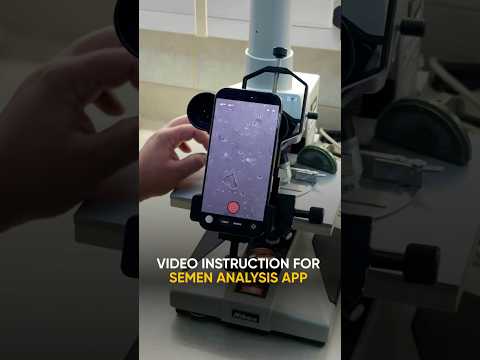
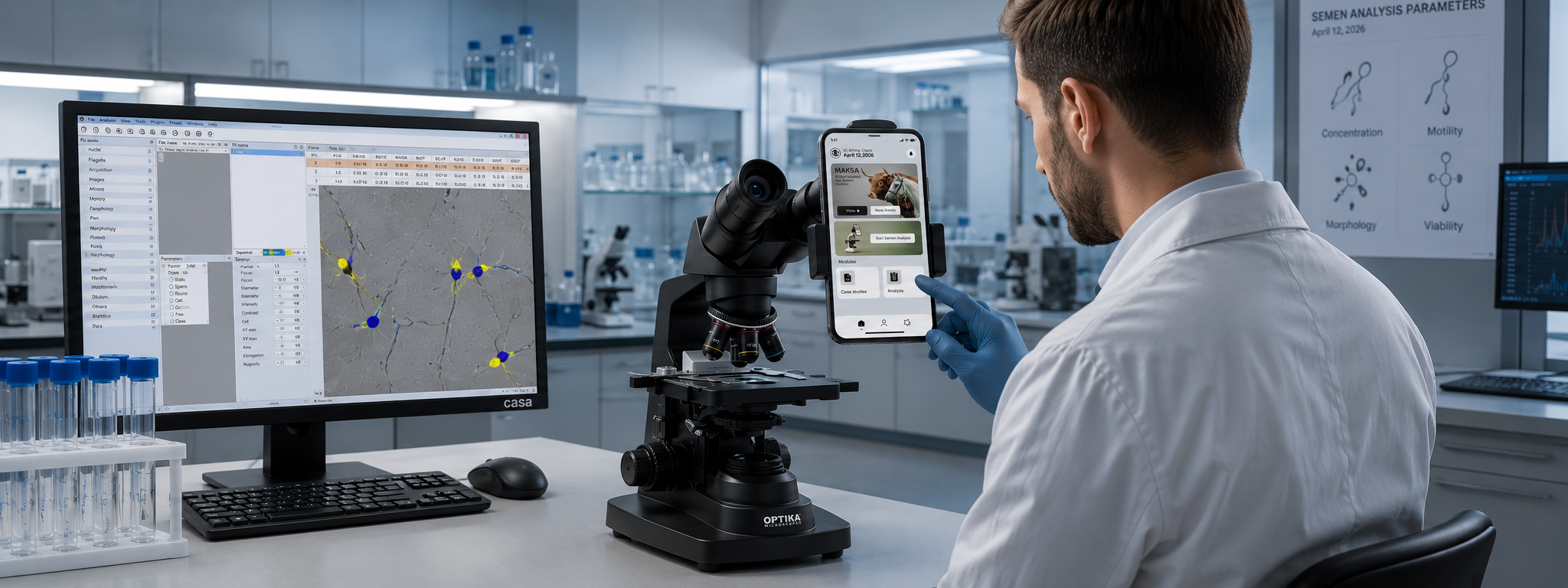
Avare App (MAKSA technology) puts semen analysis in your smartphone: total motility, progressive motility, and concentration — next to every inseminator, in the field, with no tie to a lab bench. This is not an attempt to replace CASA. CASA is an excellent reference where it exists: precise, repeatable, a deserved gold standard. But it is expensive, fixed to the lab, and physically absent from most field stations and farms. That is exactly the gap Avare App fills — a reliable read at the point where insemination actually happens and where there is no CASA.
In studies, MAKSA correlates with CASA systems at r > 0.90 — meaning results are statistically equivalent for field use. The QA protocol lets you see that on your own samples: cross-check Avare App's readings against recognized references and confirm the numbers line up in your conditions. There are two references:
- CASA — a precise, repeatable reference where the system is available on site. The ideal second pair of eyes for the cross-check.
- Manual counting — a reference available almost everywhere. But it is only as steady as the hand and eye behind it: an internal audit at one AI center found an 18-point conception gap between three technicians handling identical semen from the same bull on the same day. If technique varies that much on the floor, it varies at the counting chamber too.
The point of the protocol is to make your semen analysis more accurate and more reliable. You compare Avare App's readings against other systems on the same sample, on the same day, in your conditions, and confirm the numbers agree. Confirmed agreement means one thing: the app's result can be trusted, and the quality of your analysis stays steady from straw to straw.
How the protocol works: one sample, cross-checked
You take 3–5 frozen–thawed straws from different animals. For each straw you take a reading in Avare App, then run the same sample through the references — CASA (if available on site) and a manual count under the microscope. You record total motility, progressive motility, and concentration for every method, side by side, and see how far the app's readings sit from the references.
That is the entire logic. The discipline is in the execution: thaw the straw correctly (37 °C, 30–45 seconds), pre-warm the slide to 37–38 °C, and — this matters more than people expect — match the loaded volume to your cover-slip size. Too much or too little sample under the glass changes the depth of the field, and a wrong depth quietly biases concentration and motility for every method at once. The full protocol includes the cover-slip-to-volume table, the recording sheet, and the step-by-step so the comparison is fair.
The number that tells you whether to trust the number
This is where the validation protocol stops being a suggestion and becomes a standard. The acceptance criterion is simple:
- ±10–15% difference between Avare App and the references = acceptable. The app agrees with CASA and the manual count. Trust the number.
- More than 15% deviation = investigate. Attach photo or video evidence, and repeat with a fresh slide.
A spread above 15% is not a rounding error — it is the method telling you something is off: loading volume, slide temperature, an air bubble, or a real discrepancy worth chasing before it reaches a cow. Most "the app and CASA disagree" complaints disappear the moment volume is matched to cover-slip size and the slide is properly warmed. The threshold turns a vague worry into a clear pass/fail you can put in a report.
You don't have to waste the straw
The most common objection to validation is that it burns inventory. It doesn't. Pulling 10 µL from a 0.25–0.5 mL straw does not prevent insemination if it is done immediately. Best practice at AI stations is to take a single drop from the straw for the Avare analysis and inseminate the remaining ~90% right away. You validate your method and breed the cow from the same straw. There is no trade-off to manage.
Why a 15% error is not a 15% problem
A measurement error does not stay inside the spreadsheet. It walks straight into your conception rate. Reject a good batch on a falsely low motility read and you have discarded paid-for genetics. Approve a weak batch on a falsely high read and you have inseminated cows that will come back open. The cost is the same one that runs through every article on this site: a cow that fails to conceive at first service costs roughly $622 in repeat treatment, management, and a stretched calving interval, and cows needing three or more services cost over $205 per head per year. Across a 500-cow herd, the gap between a 44% and a 56% conception rate is 60 open cows. A measurement you cannot trust is not cheaper than a good one — it is the most expensive instrument in the station, because it bills you 35 days after the mistake, with interest.
What this means for practice
Validating your analysis method is not a research exercise — it is a production control, the same way pre-cooling tweezers and timing the thaw are production controls. Run the QA protocol at the start of each season, after any equipment or software change, and any time a method gives you a result you would not have expected from that bull. Three to five straws and one afternoon buy you a season of numbers you can actually act on. Everything else you do — handling, storage, dose math — assumes the analysis is right. This is how you stop assuming and start knowing.
Download the protocol
Download the full Avare App QA Protocol PDF — the complete step-by-step, the cover-slip-to-volume table, the example recording sheet, and the ±15% validation thresholds. Run Avare App against CASA and manual count this season, confirm it for yourself, and put a trusted number behind every insemination.